By PR | 01:11 AM March 22, 2024

The Embassy of Japan and the United Nations (UN) Food and Agriculture Organization (FAO) turned over projects aimed to restore livelihood and enhance farmers’ and fisherfolks’ resilience affected by Typhoon “Odette” (international name: “Rai” ) in 2021.
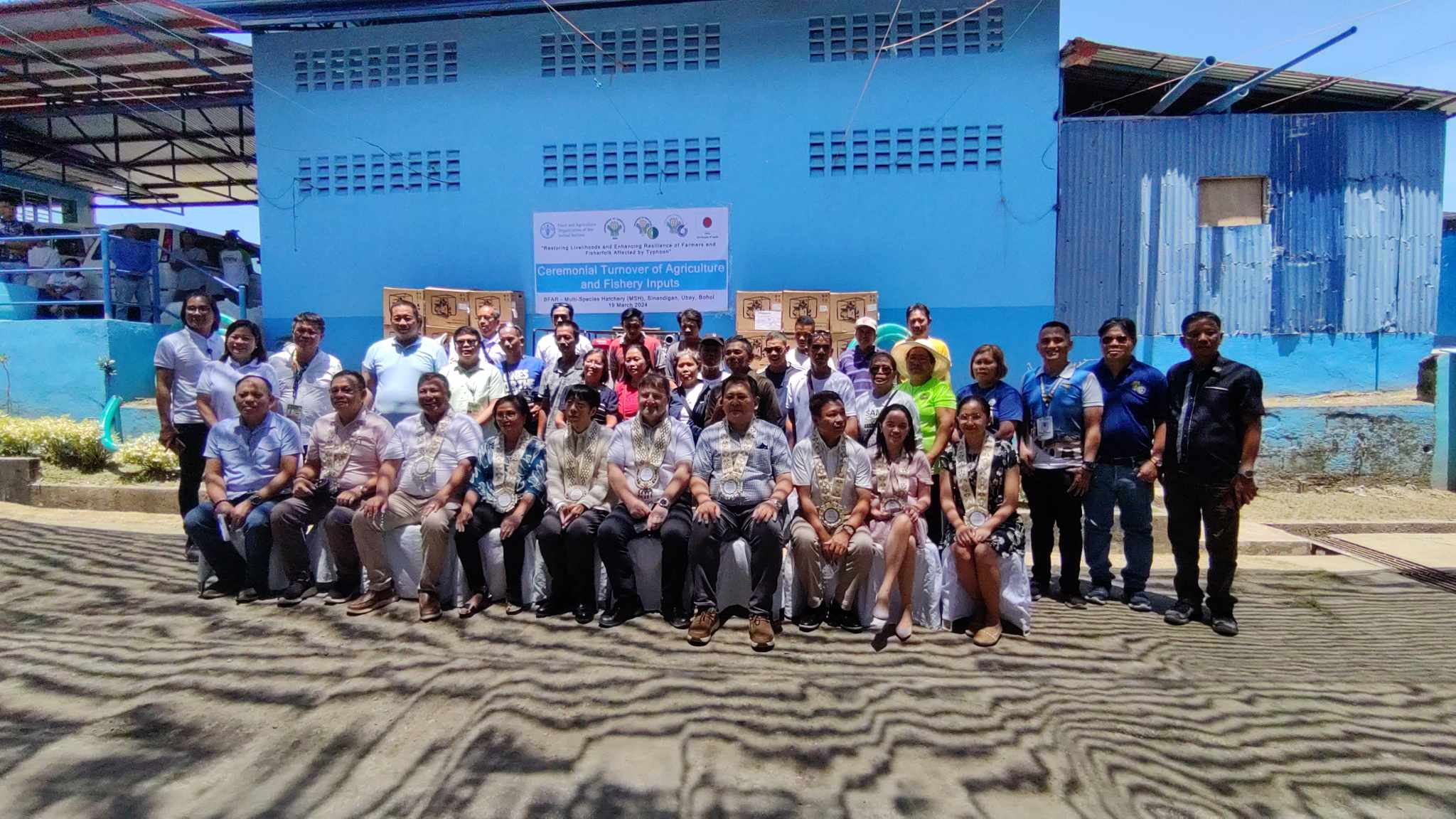
Tachikawa Jumpei, First Secretary and Agriculture Attache, and Dr. Lionel Dabbadie, FAO representative, graced the event held at BFAR’s Multi-Species Hatchery in Sinandigan, Ubay, on March 19.
A total of 1,333 households from Pres. Carlos P. Garcia (Pres. CPG), Mabini, and Ubay will benefit from the two-component projects worth $1.88M US, including the restoration of coconut-based and fishery-based livelihood and capacitating organizations and communities on climate-resilient production systems and social protection mechanisms.
Overall, three regions benefit from the project, including Bohol in Region 7, Southern Leyte in Region 8, and Surigao del Norte in Caragan Region, with a total of 4,000 households of small-scale coconut farmers and fisherfolk.
For agri-inputs, the embassy donated 1,333 assorted lowland vegetable packets, 300 bags each of urea and complete fertilizer, 1,000 heads of ready-to-lay pullets, and 300 growers and layer feeds for six community-based organizations.
Fishery donations included milkfish fingerlings for 31 fish outposts (FOs) or cages, assorted fish feeds for the 192,915 milkfish fingerlings to be stocked in the 31 FOs, and materials for assembling eight sets of drift gillnet for eight household beneficiaries in Ubay and Pres. CPG.
Various trainings to be provided are on capacity building, production of milkfish in cages, retooling vegetable production, and backyard poultry production, with each town receiving a set of automatic weather stations, including operation training at DOST.
Through the weather stations, a short messaging service (SMS) named SAGIP Buhay and Saka will provide weather updates from PAGASA to farmers, fishermen, and other stakeholders to help manage climate risks and reduce losses and damage to life, livelihood, and assets.
Nunila Pinat, executive assistant for agriculture, attended the turnover on behalf of Gov. Erico Aristotle Aumentado and expressed gratitude on behalf of the provincial government, recognizing the project’s ability to “enable beneficiaries to restart their livelihoods and to be better prepared for the challenges brought about by a changing climate.”
“We hope that this marks the start of a fruitful partnership among all stakeholders involved in this project, signifying a sincere commitment to Bohol’s economic recovery after the typhoon,” she added.
Project partners include FAO’s Office for Special Relief Operations, the Department of Agriculture, the Philippine Coconut Authority, the Bureau of Fisheries and Aquatic Resources, the provincial government, and the beneficiary local government units.
Bohol Island State University provided the validation and profiling of the beneficiaries, ensuring that the recipients were eligible for the set qualifications.
The project is poised to increase the productivity and income of Boholanos through climate-resilient agriculture and sustainable practices on the UNESCO Global Geopark regenerative island, aligned with the strategic change agenda of the Aumentado-Balite administration.
Along with representatives of partner agencies, town mayors, community-based organizations, and guests attended the ceremony. (PiMO/JSS)