By PIMO | 10:16 PM October 11, 2023


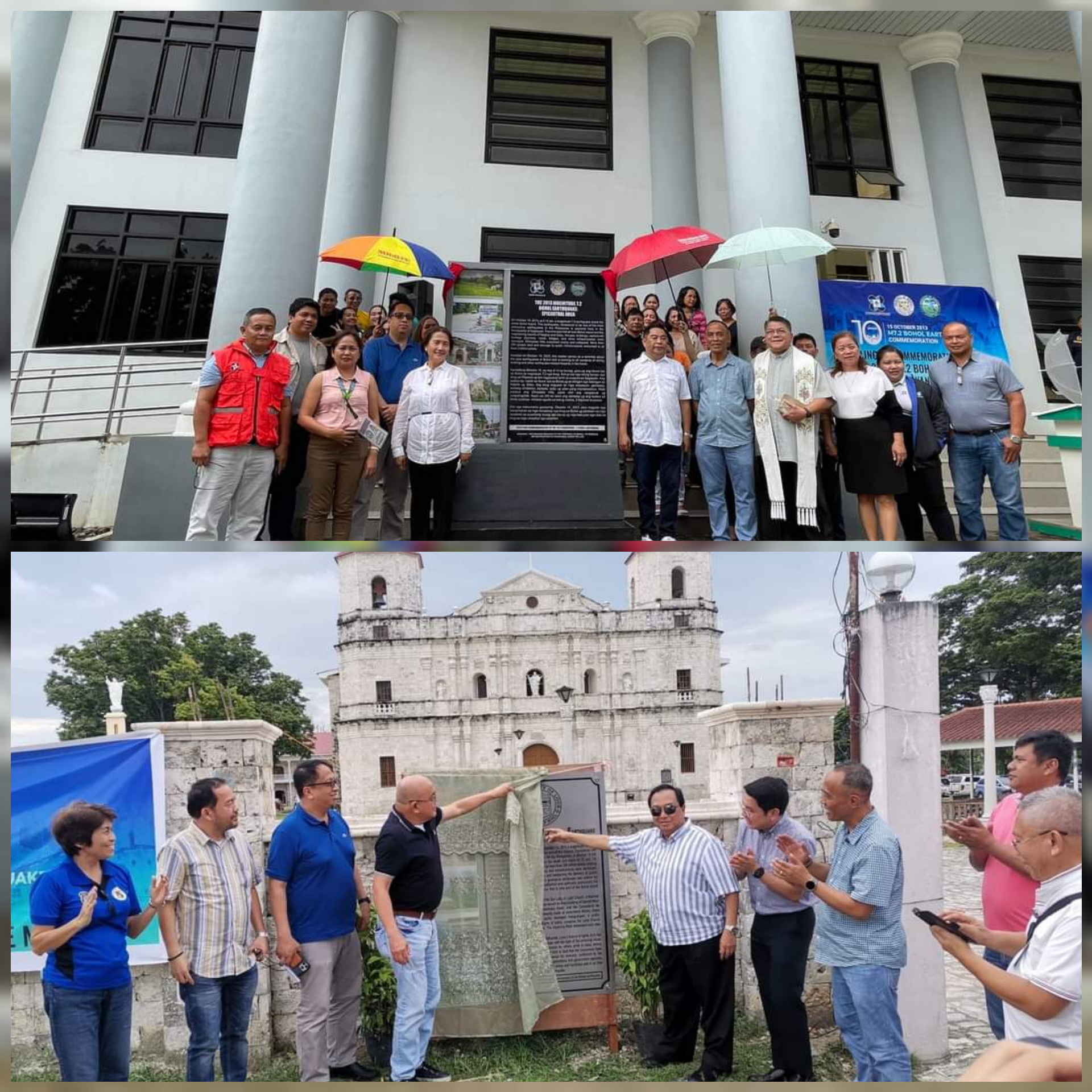
The local government units of Sagbayan and Loon in Bohol province, in partnership with the Philippine Institute of Volcanology and Seismology (PHIVOLCS) and the provincial government, unveiled the commemorative markers of the 7.2 magnitude earthquake on Wednesday, Oct. 11.
In Sagbayan, it was held at the Sagbayan Municipal Hall, a structure badly damaged during the 7.2 magnitude earthquake on Oct. 15, 2013.
The marker, placed at the municipal hall, is a reminder to the Boholanos of the destruction brought upon the island during the earthquake that took the lives of 209 people in the province and destroyed more than 71,000 structures, including built heritage structures.
Municipal Mayor Restituto Suarez and Vice Mayor Asuncion Ybañez led the ceremonies, attended by the Sangguniang Bayan members, municipal department heads, and employees.
“It is a chance for us all to remember these people and their loved ones who grieved with them. Pulo na ka tuig ang nilabay pero presko pa sa atong huna huna ang mga panghitabo ug sakit siya palumdomon,” Suarez said in his welcome address.
The mayor noted that the town has slowly risen from the tragedy.
“Pero, hinay hinay kita ni bangon ug karon ania na kita sa 2023 nga mibarog, mibangon nga mas lig-on sa pag-atubang sa mga pagsuway sa atong lungsod,” Suarez added.
Also present were Vice Gov. Dionisio Victor Balite, representing Gov. Aris Aumentado at the event, and Dr. Teresito Bacolcol, PHIVOLCS director, who both gave messages of support and praised the resiliency and the Bayanihan spirit Boholanos display amid tough conditions caused by natural hazards.
Balite paid tribute to those who lost their lives in the tragedy, calling them “heroes in their own way,” as the earthquake became a catalyst for more Boholanos to be interested in seismology and disaster preparedness.
Bacolcol, for her part, praised Bohol’s unique geology, composed of karst topography and limestone formations, evident in the island’s designation as the first UNESCO Global Geopark in the country.
The director added that she hopes LGUs have increased their preparations in the event of another major earthquake, saying the aftermath of 2013 should serve as a reminder to build safer, earthquake-resistant infrastructures and implement robust risk reduction measures.
Sagbayan was recorded as the epicenter, 6 km in the southwest area, and has a 12 km depth, with a level eight seismic intensity that took the lives of 18 people in the municipality.
PHIVOLCS described the 2013 phenomenon as a unique occurrence, being the first recorded reverse thrust fault-type earthquake to happen inland in the Philippines, as most of its kind arises off-shore.
A thrust fault earthquake is where the ground movement goes up vertically rather than horizontally. This explains why some areas in Bohol, such as Loon and Maribojoc, experienced land uplifting since the island’s geology was reverse fault dominant.


In Loon town, the same marker was unveiled on Wednesday.
The unveiling ceremony was held at Our Lady of Light Parish Church at its entrance gate.
The ceremony was led by Mayor Elvi Peter Relampagos, together with Rep. Edgar Chatto of the first district, Balite, Bacolcol, Dr. Anthony Damalerio, Provincial Disaster Risk Reduction Management Office head, John Maraguinot, and Parish Priest Fr. Desiderio Magdoza.
Relampagos honored the lives lost and the families displaced due to houses and infrastructures destroyed 10 years ago. The town was dubbed as the most devastated municipality in Bohol during the 2013 earthquake, with 72 deaths, 136 injured, and an estimated damage worth. P330 million.
“Today, we pause to remember the lives lost, we pause for the families still in mourning, and we pause for Loon still recuperating. Until today, we cannot say that we have recovered 100 percent, but we can say that almost everything is good and back to normal,” Relampagos said.
The mayor thanked the provincial government, the national government agencies, and non-government organizations who stood by Loon to aid in its distress in the aftermath of the earthquake.
Chatto, Balite, and Maraguinot emphasized the resiliency of Loonanons during the hardships they experienced in the aftermath, highlighting faith in God, faith in other people, and faith in self as significant foundational qualities that led to the town’s recovery a decade later.
Loon experienced an alteration of its geological landscape, particularly the Loon uplifted marine terrace, a known 417-hectare geosite of the Bohol Island UNESCO Global Geopark, that surfaced during the earthquake.
The powerful earthquake reduced the Our Lady of Light Parish’s coral stone structure into rubble. The church was finished in 1864 and had other historical structures in its complex, such as the old convent, the six-sided Morada, and the Cementerio de Mamposteria.
The reconstruction of the church started in 2017 and was completed and turned over by the National Museum of the Philippines to the Diocese of Tagbilaran in 2021. It was declared as a National Cultural Treasure by the National Museum of the Philippines and a National Historical Landmark by the National Historical Commission of the Philippines. (PIMO/GMC)