By Ric Obedencio |09:37 AM December 04, 2023

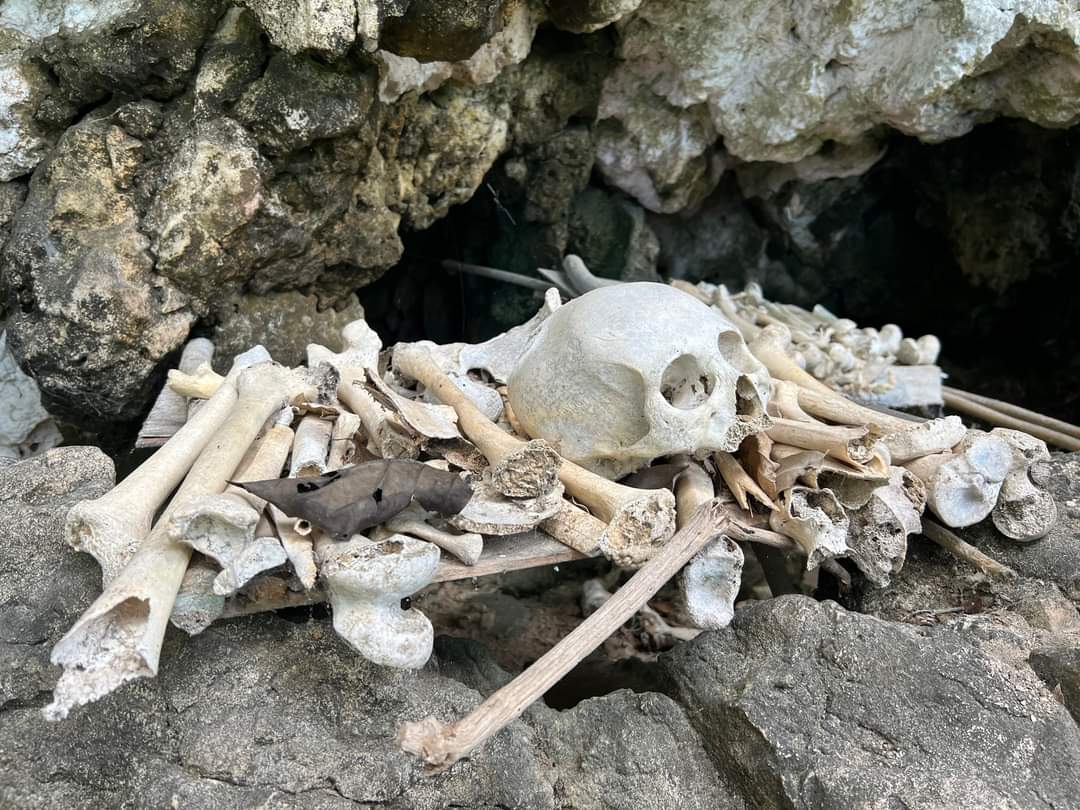
Unknown to many, the said to be best kept secret of ancient graveyard with coffins made of wood, artifacts and human remains somewhere in barangay Malinao, Garcia-Hernandez town was revealed recently.
Concerned officials on November 23, the National Museum of the Philippines – Bohol, in coordination with the Provincial Government of Bohol’s Center for Culture & Arts Development (CCAD) Bohol and Garcia Hernandez, Bohol investigated the condition of the Kalagan Rock shelter in said barangay. This prompted after the request of the National Commission for Culture and the Arts– Cultural Properties Protection and Regulation Division (NCCA)
But for John Ochavillo, planning officer of this town who has been visiting this place, it was a revisit of the place called Kalagan, believed to be a pre-colonial burial site during 12th-14th century.
The said burial site is located at barrio Malinao. Residents called the place “Kalagan,” from the local word “kalag” (soul or spirit), on the belief of the presence of ancestral spirits in the site, National Museum said in its fb post.
“A follow-up exploration and preliminary examination of the coffins and human skeletons at the site was conducted Wednesday, November 29, by Mr. Taj Vitales, Senior Museum Researcher of the NMP’s Archaeology Division. Vitales identified at least nine individuals buried at the rock shelter. An intact skull from the site showed evidence of #ArtificialCranialDeformation, a cultural tradition practiced by pre-colonial Visayans. The team also observed modern alterations at the rock shelter.”
As the result of the assessment, the NMP team has strongly recommended to LGU here to enact an enabling local law for the preservation and protection of the site.
“The team also emphasized the importance of proper conservation of these archaeological materials as they play a salient role in defining the narrative of the place. Furthermore, the NMP team suggested seeking assistance from the Regional Cave Committee (RCC) for further assessment.”
For the meantime, the Department of Environment and Natural Resources (DENR) Bohol has regulated entry to the site. Punong Barangay of Malinao Honorio Jaminal strictly prohibits entry to the site as well, according to Ochavillo.
Ochavillo cited some of the measures protecting the site: the Intentional disturbance of Ancient Burial Sites could lead to prosecution, Republic Act No 10066. Violations of Republic Act 9072 also known as the National Caves and Cave Resources Management and Protection Act could lead to prosecution. Violations of Presidential Decree 705 also known as the Revised Forestry Code could lead to prosecution. Permit to Explore, Certificate of Authority to Supervise Excavation (rescue Archaelogy) from NCAA is mandatory.
This is what Ochavillo has said on the finds: “The old human remains, coffins and artifacts need preservation. The coffins have distinct designs and style and the site is worthy of further study/exploration. Exposure of these things to the natural elements may cause further damage. Due to the recent declaration of Bohol as UNESCO geopark these are considered/presumed important cultural properties. Some features of the coffins are unique and not found in pre-colonial coffins of Bohol. A human skull probably female has a dented forehead; a modified forehead characteristic of pre colonial Bisayan of high social status. Remarkably a tooth with reddish dyeing/discoloration was a result of buyo chewing. These bones probably belong to prominent family but there is no assurance of relations. The same size coffins and design may point to a single carver/craftsman. Fissures and cracks under the overhang are observed thus the site is a rock-fall hazard.” (rvo)