By I. Inojales | 09:30 AM December 21, 2025

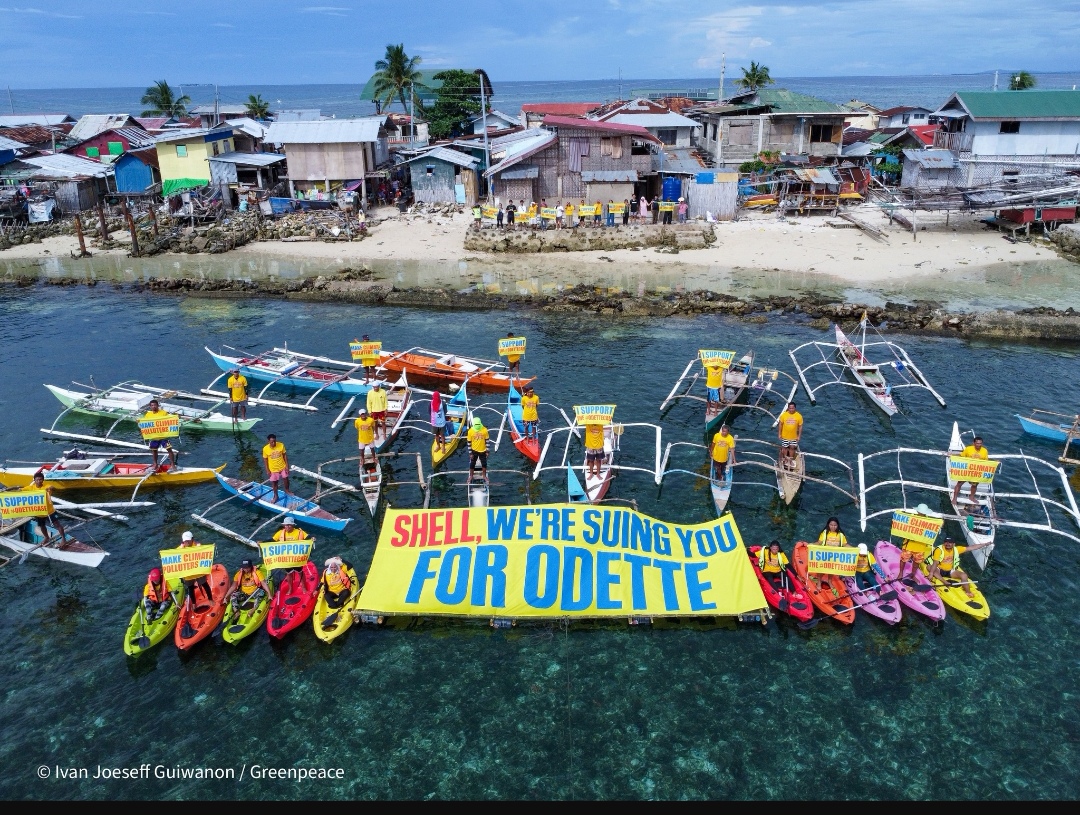
MANILA, Philippines — Survivors of Super Typhoon Odette from the hard-hit towns of Tubigon and Ubay in Bohol are among 67 Filipinos taking an unprecedented legal stand against global oil giant Shell, more than three years after the disaster claimed over 400 lives and destroyed 1.4 million homes nationwide.
On October 23, 2025, UK-based law firm Hausfeld served a Letter Before Action to Shell’s headquarters in London, signaling a planned lawsuit that links the company’s decades of carbon pollution and alleged climate denial to the devastation wrought by Odette (international name: Rai).
If filed in December as scheduled, the case would be the first civil lawsuit to directly connect a fossil fuel company to deaths and injuries in the Global South caused by a specific climate disaster.
Voices from Tubigon and Ubay
For families in coastal barangays of Tubigon and Ubay, Odette was not just a storm—it was a turning point that erased homes, livelihoods, and loved ones in a single night. Many survivors say they are still rebuilding, while living in constant fear of the next typhoon.
“These communities did not cause the climate crisis, yet they paid the heaviest price,” the Odette Case campaign said, noting that residents of Tubigon and Ubay were among those who lost fishing boats, homes, and sources of income when storm surges and violent winds flattened coastal villages.
The claimants argue that stronger and more destructive storms like Odette are being fueled by climate change—driven largely by fossil fuel emissions from companies such as Shell.
Holding polluters accountable
The legal action seeks financial compensation and possible court orders under the “polluter pays” principle, asserting violations of the constitutional right to a balanced and healthy ecology.
While the claims are grounded in Philippine law—including quasi-delicts, unjust enrichment, and environmental rights—the case will be filed in UK courts, where Shell is headquartered, applying Philippine legal standards through conflict-of-law rules.
The lawsuit is supported by the Odette Case campaign, coordinated by Greenpeace Philippines, the Legal Rights and Natural Resources Centre (LRC), the Philippine Movement for Climate Justice (PMCJ), and Uplift.
Science and precedent
Odette made landfall on December 16, 2021, as the strongest typhoon to hit the Philippines that year. Scientific studies cited by the campaign show that climate change more than doubled the likelihood of extreme storms with intense winds and rainfall like Odette.
One study by experts from the Centre for Environmental Policy, the Grantham Institute, and the University of Sheffield concluded that “human-induced climate change has likely more than doubled the risk” of such compound weather events.
The case also draws strength from the 2022 Philippine Commission on Human Rights (CHR) report, which found that major fossil fuel companies, including Shell, could be held accountable for contributing to climate harms and obstructing climate action.
Why Shell?
According to the Odette Case, Shell is among the world’s largest historical carbon emitters, responsible for an estimated 41 billion tons of CO₂e from 1892 to 2023, or about 2.5 percent of global emissions.
Internal documents show Shell was aware as early as the 1960s—and explicitly by 1988—that fossil fuels could cause severe climate impacts, particularly in developing countries. Despite this, claimants allege the company continued expanding oil and gas operations while lobbying against climate solutions.
A fight beyond Bohol
Alongside claimants from Tubigon and Ubay are survivors from other Odette-ravaged areas in Cebu and nearby islands. Many remain displaced or economically vulnerable years after the typhoon.
Legal experts say a favorable ruling could set a global precedent, opening the door for climate-vulnerable communities worldwide to seek damages from major polluters.
If Shell fails to provide a satisfactory response to the Letter Before Action, the lawsuit will be formally filed in December 2025.
For survivors in Tubigon and Ubay, the case is about more than compensation.
“From fighting for survival to fighting for justice,” the Odette Case campaign said, “these communities are using the law to demand accountability—so that what happened to them will not be repeated for future generations.”