By PR | 09:27 PM March 15, 2024

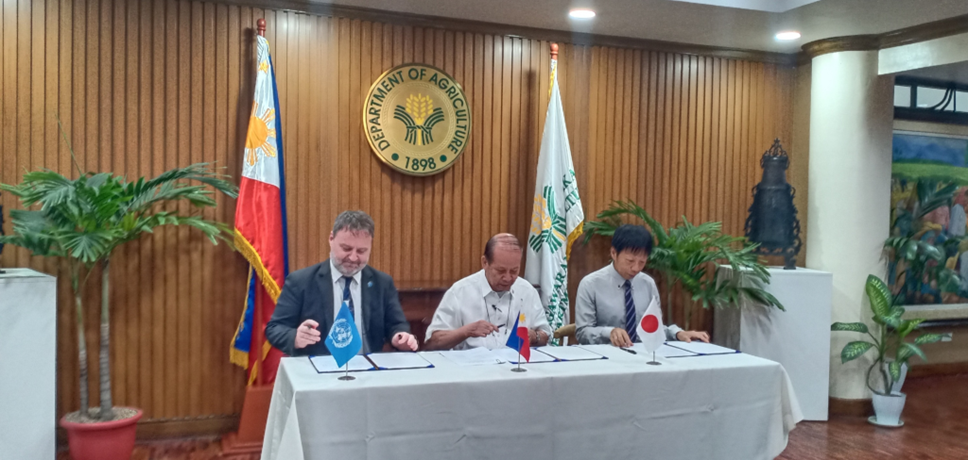
Bohol expects to be a beneficiary of a project from Japan’s Embassy and the United Nations’ Food and Agriculture Organization (FAO) that aims to restore livelihood and enhance farmers’ and fisherfolks’ resilience affected by Typhoon “Odette” (international name Rai) in 2021.
Gay Therese Bucol, FAO team leader revealed this during her visit to the Capitol on March 14 for the upcoming Bohol visit of the Japan Embassy’s Tachikawa Jumpei, First Secretary and Agriculture Attache; and Dr. Lionel Dabbadie, FAO representative.
The coordination meeting, led by supervising administrative officer Metodio Maraguinot Jr., discussed logistics, security, and safety preparations for the event and was attended by partner offices.
Jumpei and Dabaddie will grace the ceremonial turnover of agricultural and fishery inputs on March 19 at the Multi-Species Hatchery in Sinandigan, Ubay.
The project, funded by the Japanese Embassy and implemented by FAO, aims to restore and promote the resilient livelihoods of 4,000 small-scale farmers and fisherfolk affected by “Odette”.
Three regions will benefit from the project, including Bohol in Region 7, Southern Leyte in Region 8, and Surigao del Norte in Region 13 with a total of 4,000 households of small-scale coconut farmers and fisherfolk.
To benefit 1,333 households in the towns of Carlos P. Garcia, Mabini, and Ubay, the two-component projects will restore and improve livelihoods through diversified income sources.
This includes the restoration of coconut-based and fishery-based livelihoods and capacitating organizations and communities on climate-resilient production systems and social protection mechanisms.
The beneficiaries will receive agricultural inputs, including assorted lowland vegetable packets, urea and complete fertilizers, ready-to-lay pullets, grower feeds, layer feeds, and 30 water pumps for each community-based organization.
For fishery inputs, the towns will also receive milkfish fingerlings, assorted fish feeds, and materials for assembling drift gillnet.
Also included in the project are training on capacity building, production of milkfish in cages, retooling vegetable production, and backyard poultry production.
The beneficiaries will also receive a set of automatic weather stations, including training for operation.
The multi-component project is poised to increase productivity and income through climate-resilient agriculture and sustainable practices on the UNESCO Global Geopark regenerative island, aligned with the strategic change agenda of the Aumentado-Balite administration.
Project partners include FAO’s Office for Special Relief Operations, the Department of Agriculture, the Philippine Coconut Authority, the Bureau of Fisheries and Aquatic Resources, the Provincial Government of Bohol, and the beneficiary local government units. (PiMO/JSS)